French people are somehow quite aware of their incomplete information regarding energy matters. According to a poll that was done as a prerequisite to the national debate on energies, and that yielded a couple of surprising results, more than two thirds (70%) of my fellow citizens considered themselves as very poorly or poorly informed on energy issues.
So, if almost two thirds of French people declared that they were very (13%) or pretty (50%) concerned by energy savings, it is pretty likely that the idea that people have of what is a significant saving is often partially wrong. The poll, alas, did not ask the following question : “to your opinion, what are the behaviours that allow significant energy savings ?”, but if I judge by the personal conversations that I can have here and there, buying low consumption light bulbs and switching off device instead of putting them in standby mode are two items that would probably have ranked high.
More generally, the debate on energy savings, in France, is often actually discussing electricity savings, forgetting that it is oil, and by far, that represents the first of our final energies, that is energies that are sold to individual consumers or companies.
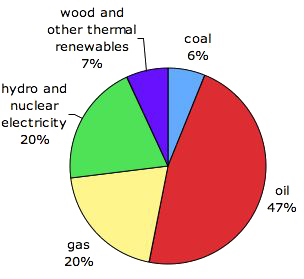
Breakdown by nature of final energy consumption in France in 2002.
Nuclear and hydro account for 90% to 95% of electricity generation in France.
Source : French ministry of industry, 2004
As France consumed roughly 175 million tonnes oil equivalent of final energy per year (in 2000), and knowing that a tonne oil equivalent is equal to 11.600 kWh, this means that each French person consumes, in average, 34.000 kWh of final energy per year, all energies aggregated.
Well, lighting a home for a year consumes, on average, 450 kWh of electricity. Easy conclusion : energy savings that would be limited to efficient light bulbs would not represent much ! In France, lighting homes represents 3% of the total electricity consumption, that is, depending on the way to calculate, from 0,6% to 1,2% of the global energy consumption of the country. It is definitely possible to put efficient light bulbs everywhere, but it will not changes much the situation, and, as the below graph indicates, “large” savings have to be done elsewhere.
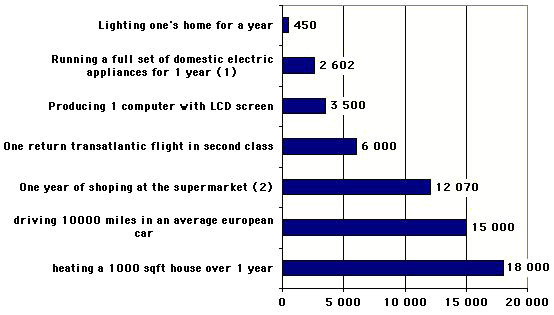
A couple of examples of “energetic contents” for various components of everyday life in occidental countries
Notes :
(1) a full set of appliances comprises a fridge, a freezer, a washing machine, a dish-washer, a cloth dryer, a stove, and a set of electronics (TV, VCR, radio, telephone, etc). the indicated value represents the overall consumption of this ensemble, gas and electricity agregated (but electricity has the lion’s share).
(2) This amount corresponds to the total energy consumption of the manufacturing industries to produce the goods that an average french person buys in a supermarket over one year (processed foods, shoes, games, CDs, shampoo…. It does not account for good transportation.
The last line (heating) actually totals heating and sanitary hot water, and is valid for fuel oil or natural gas heating. With electricity, the final energy consumption is 2 to 3 times lower, but the primary energy consumption about the same.
Sources : Olivier Sidler, 1999 (heating and domestic appliances), Williams/Kluwer, 2004, adapted by Jancovici (computer), Jancovici for the other lines, from CEREN for the last, and from ADEME for the before the last.
Suppose we discuss road transportation. Then “savings” bear three names, that are :
- not driving, and instead taking the bus, the train, walking, and cycling : switching from an energy intensive way to move (car or plane) to a non energy intensive way (walking, cycling, or the underground) leads to a saving (in France, and more generally in Europe) of 10.000 to 15.000 kWh per year, that is 20 to 35 times the lighting of an average home,
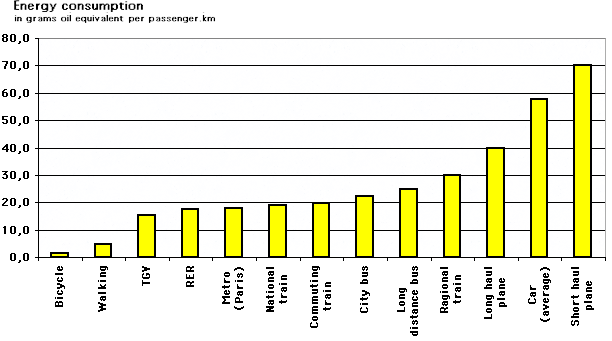
- using one’s car as little as possible : driving 7.000 km (roughly 4.000 miles) per year rather than 15.000 (roughly 8.500 miles, or the average distance driven by every car owner in France) allows to save 8.000 kWh, which is still 20 times the lighting of an average home!
- buying a car as small as possible :
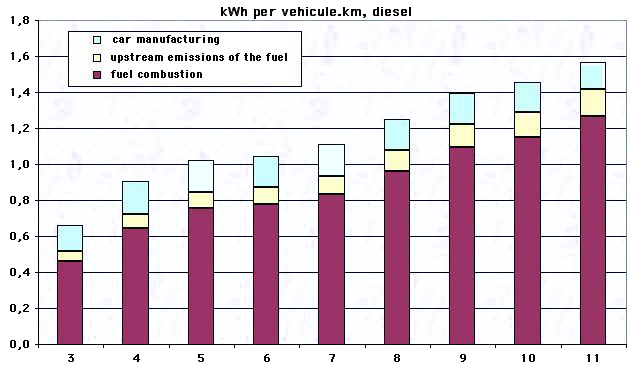
Energy consumption per km for diesel cars in France, depending on the administrative power (fiscal horsepowers, that more or less represent the effective power of the engine).
The direct energy consumption is separated from the energy needed to build the car and the energy needed to extract, transport and refine the fuel used.
Buying a small car (not powerful) has a much greater importance for future savings than stoping the engine at red lights after.
Source: Jancovici/Ademe, 2004 (consumptions have been obtained from field data, and not from the UTAC standards, about 30% lower !).
If we look at buildings, now, that absorb 45% of the energy consumed in France (heating and electricity use), the three main sources of savings are, ranking from the highest :
- drastically insulate one’s home : it is then possible to save up to 75% of the initial consumption ! On the basis of 18.000 kWh per year and per home for heating (excludes air con), this puts at hand 13.000 kWh of possible savings, that is 20 times the lighting of an average home,
- take showers instead of baths : sanitary hot water uses about 6% of the global primary energy consumption of the coutry, that is about 2.500 kWh of primary energy by French person (I do not have the figures regarding final energy, alas) ;
- avoid as many domestic appliances as possible (which raises an interesting set of questions, because I often heard that “it was not possible to do without this” or “without that” for appliances that came on the market only 10 or 20 years ago…..). A cloth dryer consumes about 450 kWh yearly, that is as much as the lighting of an average home.
Should we begin by modest savings ?
The above figures are unfortunately unambiguous : replacing 3 light bulbs, or savings 3 paper sheets (what allows to avoid spending energy to manufacture them), are not “ecological gestures” of the proper magnitude to meet the energy or the climate challenges, and by far. But it is frequent to hear that it could be a “good start”. Saying so is assuming that (s)he who buys 3 low consumption light bulbs will be more prone that somebody else, afterwards, to leave one’s car in the garage, lower the inner temperature of one’s home, unplug the air con, quit flying or resist better than the rest of the population to the buying frenzy of material goods (that had to be manufactured, what consumes energy, then transported, what also consumes some).
While we should avoid to make a general statement out of what happen in front on one’s door, I have frequently noticed that one who buys a couple of low consumption light bulbs had not gave up, otherwise, living in a vast and poorly insulated home, flying several times a year, driving an important yearly mileage, or buying as many manufactured goods than before.
On the other side, some “major energy savers”, avoiding planes, lowering the thermostat, etc, may well not own a single low consumption light bulbs at home !
From there, it seems to me that affirming that “low consumption light bulbs is the first step towards more significant action” remains to be proven ; it might well be, on the opposite, the “good deed” done by people that do not have the slightest intention to decrease the bulk of their energy consumption (or more exactely to decrease it voluntarily) and that buy such device as a kind of “redemption” for the rest ; a total absence of correlation being also possible, which would mean that less heating, less flying, less freezing, less buying and less driving is equally difficult for those that own a couple of low consumption light bulbs and those that do not own some. In France, to my best knowledge, no study has been conducted that would allow to answer that question.
If getting an answer to this question (whether low consumption light bulbs are a true first step) is not possible, maybe some other fields than energy consumption allow to get some hints ? For example, do all overweight people that went on a serious diet started by replacing sugar by aspartame in their coffees while keeping eating cakes and ice-creams, or is such a behaviour reasonnably allowing, on the opposite, to suppose that nothing more serious than avoiding sugar in the coffee will ever be done ?
Are energy savings just a matter of technical progress?
Since 1974, year of the first oil shock, the producers of device that consume energy (houses, cars, domestic appliances, etc) have made tremendous progresses : heating a modern french house requires 2 to 3 times less energy, per square metre, than an old one ; moving a tonne of car requires much less energy than 20 or 30 years ago ; we must burn less jet fuel to bring a plane passenger from Paris to Marseilles than in 1975 ; and all this explains that we often hear that we have realized “savings”.
For a given device it is true, but this did not lead the least to a decrease of the overall consumption, that, since that year, has tremendously increased !
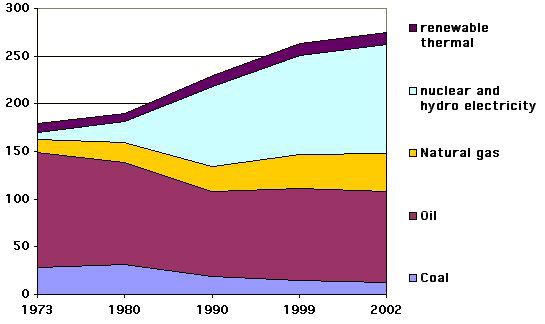
Primary energy consumption in France, by type of energy, from 1973 to 2002, in million tonnes oil equivalent.
(one tonne oil equivalent = 11600 kWh).
Source: French ministry of industry, 2004
The decrease of the oil consumption on the above graph actually hides two antagonistic effects : on one side oil has been replaced by nuclear energy for electricity generation (something that also applies, for a part, to coal ; in many other countries oil has also been removed from electricity generation after 1974 but has been replaced by coal or gas), and oil has been significantly substituted by electricity and gas in the industry, but on the other side fuel consumption for road transportation doubled since the first oil shock (in France), and jet fuel consumption (sold in France) tripled.
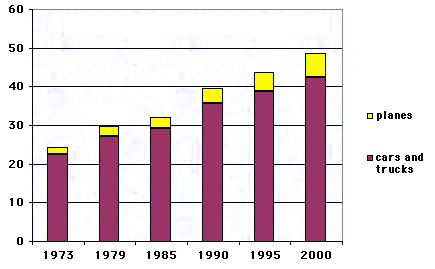
Consumption of oil products in France by end use sector from 1973 to 2002, in million tonnes oil equivalent.
(one tonne oil equivalent = 11600 kWh).
For planes, the figure corresponds to fuel sold in France, but pertains both to domestic and international flights.
Source : French ministry of industry, 2002.
So if much less gasoline is needed in 2004 than in 1974 to move a car that would have the same nominal power and weight, in the same time :
- the number of cars has doubled in France (the car fleet went from 14 to 28 million vehicules from 1974 to 2000),
- cars are heavier and more powerful : for the sole decade going from 1990 to 2000 the average power of newly sold cars increased by 20% (55 to 67 kW) and their average weight by 20% also,
- the annual mileage of each car has increased by 8% (from 13.000 to 14.000 km per year from 1974 to 2000),
Thus, if the overall oil consumption has diminished from 1974 to 1985, as a result of the sharp reduction performed by industries, it grew from 1985 on, because of the consumption of transportation uses.
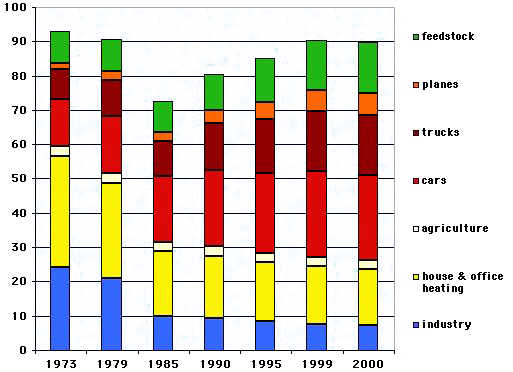
Breakdown by end use sector of oil products consumption in France, from 1973 to 2000, in million tonnes.
One will note the very fast decrease, from 1974 to 1985, of the industrial consumption (that includes electricity generation), and the rebound of the global consumption after 1985 (counter shock).
“feedstock” means the use of oil as a raw material in the chemical industry.
Source : French ministry of industry, 2002.
For oil then, that is our first final energy in France, as in many other countries, we can only acknowledge that the global consumption has not followed the efficiency obtained on device that use some (cars and domestic boilers, mostly).
We could get to the same conclusion regarding electricity : its consumption rapidly increases, in spite of the fact that today we need much less energy to cool the inside of a 200 litre fridge, to run a dish-washer of a given capacity, etc. Here again, an increase in the usage (increase in the proportion of households equiped, of the size of the device, etc) more than compensates the decrease allowed by efficiency.
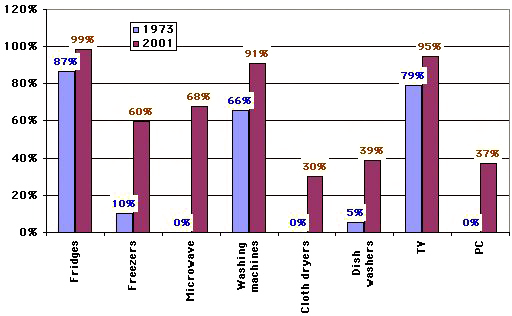
Proportion of household equipped with various domestic appliances in France in 1973 and in 2001.
It doesn’t matter whether the household owns one or several device (a household is considered as “equipped” whether it owns 1 or 4 TV sets), and whether the device are large or small (a small fridge and a huge american fridge are both worth 1).
Source : French ministry of industry, 2002
We face here what the specialists call the “rebound effect” : increasing the efficiency lowers the cost of usage and therefore allows more people to be equipped, and this evolution goes faster than the gains in efficiency. The curve below shows that we can hardly ever suggest the existence of a global saving !
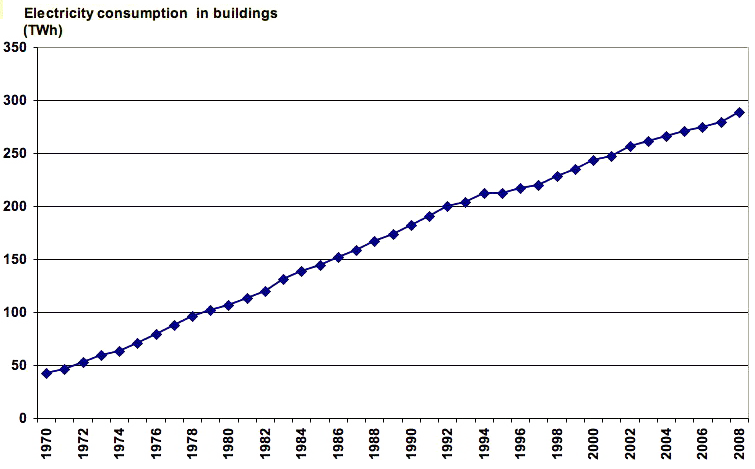
Electricity consumption for domestic and office use in France from 1970 to 2003, in TWh
(1 TWh = 1 billion kWh).
With a consumption multiplied fourfold in 30 years (electric heating excluded), it requires a certain boldness to evoke savings !
The evolution is about the same in most occidental countries.
Source : Observatoire de l’Energie and Service de l’Observation et des Statistiques
En fait, quand on regarde les choses d’un peu près, on se rend compte que la consommation suit très étroitement un indicateur qui n’est pas l’efficacité énergétique des appareils consommateurs d’énergie, mais qui est… le prix. Les carburants routiers offrent un très bel exemple, qui apparaît tout d’abord si l’on regarde comment évolue le kilométrage annuel en voiture effectué par habitant, selon le prix des carburants routiers du pays dans lequel on se trouve.
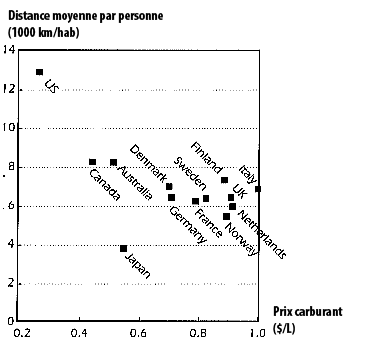
Thousands of vehicle.km per person in 1998 (vertical axis) depending on the retail price of car fuels in $ per litre that year (horizontal axis).
Obviously, the lower the price of gas, the higher the annual mileage par capita.
Source : 30 Years of Energy Use in IEA Countries, IEA, 2004.
We can then have a glance on the fuel intensity of cars (existing stock) depending on the price of car fuels, and the conclusion is exactely the same.
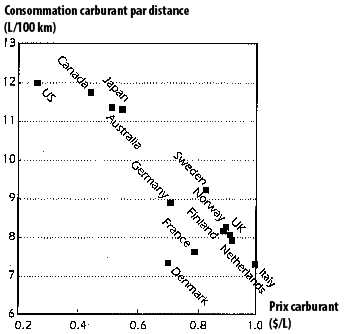
Fuel intensity of the existing car stock in 1998 (litres/ 100 km, vertical axis) axe vertical) depending on the retail price of car fuels in $ per litre that year (horizontal axis).
Sure thing, the higher the retail price, the better the fuel intensity (more km to the litre).
Source : 30 Years of Energy Use in IEA Countries, IEA, 2004.
Again ? Let’s have a look at the global car fuel use per capita depending on fuel price….
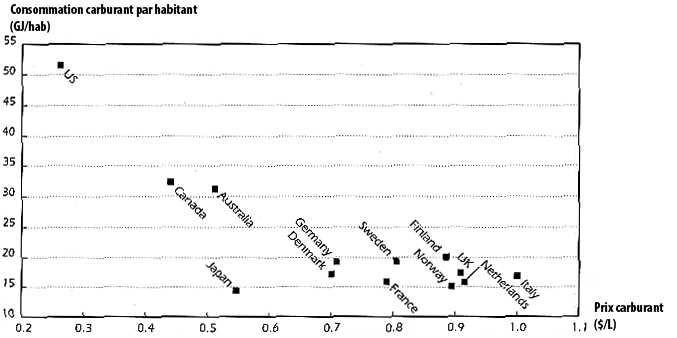
Car fuel consumption per capita in 1998 (in Gigajoules, vertical axis) depending on the retail price of car fuels that year (in $ per litre, horizontal axis).
1 metric ton of oil = 42 gigajoules
All is said : savings = high energy prices !
Source: 30 Years of Energy Use in IEA Countries, IEA, 2004
If we come back to a more “macro” approach, it has been recalled above that the oil consumption started to rise again after 1985 (in France). The chart below shows that this is precisely the year that the “counter shock” began, that is a long period during which oil prices remained very low.
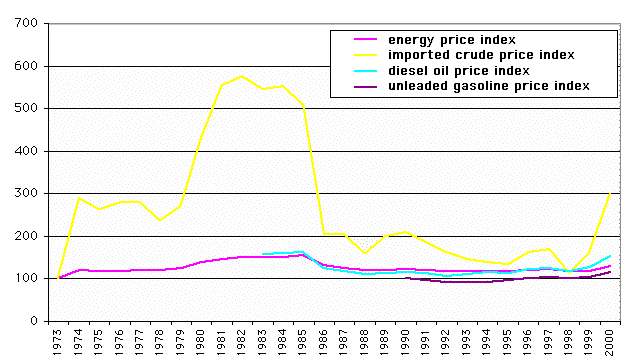
Evolution of various price indexes in France (the “imported crude price index” is actually the price of oil on world markets) – in constant currency – for various energies since 1973.
Each index is equal to 100 in 1973, except for the unleaded gasoline (100 in 1990 ; before it didn’t exist).
The “energy price index” corresponds to a mix of all commercial energies.
Source : French ministry of industry, 2001.
One will note that in France the price of energy, since 1985, has never stopped to decrease in constant currency, with the exception of the very recent years, and that observation is even more true if we examine the share of energy spendings in the average income of people. As the purchasing power – in constant currency – has doubled since 1973, the share of our income allocated to energy spendings has never stopped to decrease – at least since 1985 – and therefore we consume more and more of it.
In other terms, what recent trends show is that the first factor that will govern our future energy consumption is not the genius of some engineer that will find some brilliant idea to divide by two the energy required to move a tonne of car, but the price of energy. All the campaigns promoting energy savings should therefore be limited to one information : ask to vote for the candidate that promises to raise progressively taxes on energy !