Holy electric car ! We can now witness the multiplication of speeches in which this marvellous device is going to solve the problem of mobility in a carbon-constrained world, as sure as 2 and 2 make 4. “Clean” car here, “green” car there, “car of the future” here again… any political leader that says (s)he cares about the environment has a special thought for this device. Well, are we sure that this car, gladly presented as the ideal solution for a green future, meets this promise ? The advantages we frequently hear regarding electric cars are:
- no noise,
- no apparent pollution.
- and actully no pollution at all, since the expression “clean vehicle” is very common.
Some of this is true… but not all, as usual.
No noise?
Anyone who has driven an electric car has noticed that it is indeed less noisy than a petrol car, but:
- the absence of noise is essentially valid at low speed, as the noise generated by vehicles on wheels mainly comes from rolling as soon as they go over 50 to 60 km/h (30 to 40 mph). Friction of the wheels on the road, and friction of the air on the car itself then become the dominant components of the global noise, the one coming from the engine becoming then secondary,
- using cars only at low speed only means using them in urban trafic, precisely where cars – electric or not – generate other problems, such as congestion, the necessity to devote an important surface to streets and parking lots, and a threat to bicycles (that remains even with an electric car).
At low speed, and for a moderate trafic, though, there is a real benefit regarding noise. But… it is then somestimes necessary to produce extra noise (with a bell, for example) because otherwise the pedestrians don’t pay attention and get ran over ! New trams in Paris are equipped with bells precisely for this reason, and it seems that it gets on the nerves of the people that live along tram lines… we live a complicated world.
No local pollution?
No local pollution, then, is real where the car is used. But this car had to be manufactured ! And this process has generated plenty of local pollution “elsewhere”, just as for an regular car:
- As for a regular car, we must extract from the underground ores of all kind (iron, copper, nickel, manganese, gold, platinum, and many other metals), and all this generates local pollutions, sometimes massive,
- As for a regular car, we now need to manufacture plenty of electronics, with processes that also generate local pollution,
- As for a regular car, we must use plastics of all kind, and thus extract oil, with local pollution associated,
- The battery must also be manufactured, which requires chemical industries, metal industries, and other industries that always generate local pollution, a little or a lot,
- And, at alst, we must “get rid” of the old car when it comes to its end of life.
Incidentally, manufacturing an electric car also generates global pollution:
- As for a regular car, we need fossil fuels to produce the raw materials used (coal for steel, oil for plastics, gas for glass, a little of everything to manufacture the paint…). We also need electricity (which is first of all produced with coal and gas worldwide) and sometimes steam (also produced with fossil fuels) to put together the components of the future car,
- As for a regular car, these components must travel from one plant to another, with trucks that for the time being use gasoil!
As a result, the CO2 emissions that arise from manufacturing an electric car are about the same of what they are for a regular car, that is 5,4 tonnes CO2equivalent per tonne of car (one of the things that are often misleading in comparisons is that electric cars are generally lighter and less powerful than gasoline cars). For a car that has a “life expectancy” of 200,000 km (roughly 120,000 miles), it means that each kilomterer generates (for the manufacturing process) 40 grammes of CO2. This is not totally clean !
No global pollution?
There is a last item we’d better not forget when we discuss the benefits of electric cars: electricity has to be generated. Indeed, as there is no “natural electricity tank” where this precious fluid would be available at no cost and without pollution, we have to produce it. And thus electricity is as clean as the way to produce it, which is now done:
- With coal for 40% of the world production (this proportion rises to 50% for the US or Germany, and even higher for Australia or Poland), and coal is the dirtiest and most dangerous energy we use,
- With gas for 20% of the world production (gas generates CO2 emissions when burnt, 30% less than oil but it still not zero),
- With heavy fuel oil for 5% of the world production,
- With hydroelectricity for a little more than 15% of the world production,
- With nuclear for a little less than 15% of the world production,
- And with wind for… less than 2% of the world production (photovoltaïcs is ten times less than wind).
As a result, electricity production releases more CO2 into the atmosphere than all terrestrial, airborne and marine transportation device, with coal fired power plants alone representing a fith of the world total.
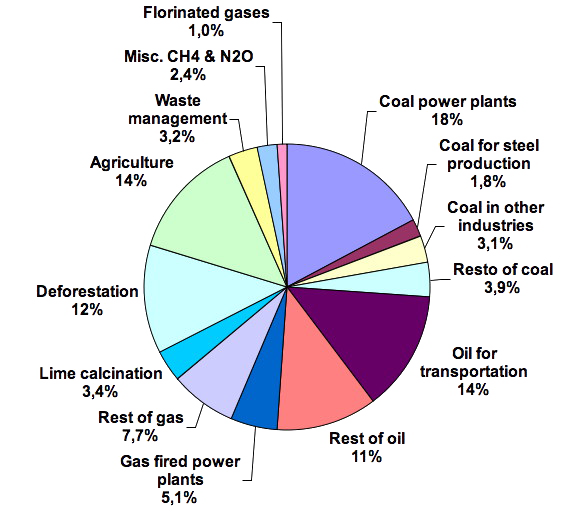
Breakdown of world greenhouse gases emissions in 2004.
Lime calcination is the process done in cement production (lime is heated over 1000 °C, and the calcium carbonate molecules are broken in calcium oxide and CO2). One will notice that coal fired and gas fired power plants together account for almost a quarter of the world emissions. Therefore considering that “running on electricity” is pollution free is a debatable conclusion !
Author’s compilation on CDIAC (lime calcination), Houghton et. al 2005 (déforestation), IPCC AR4, International Energy Agency, BP statistical review.
Emissions arising from electricity are of course very variable from one country to another, depending on the energy mix used. NB: the graph below doesn’t account for emissions coming from extraction and processing of the fuel, what increases by 10 to 20% the emissions per electric kWh for fossil fuels, and adds 10 to 20 grammes of CO2 for nuclear and hydro).
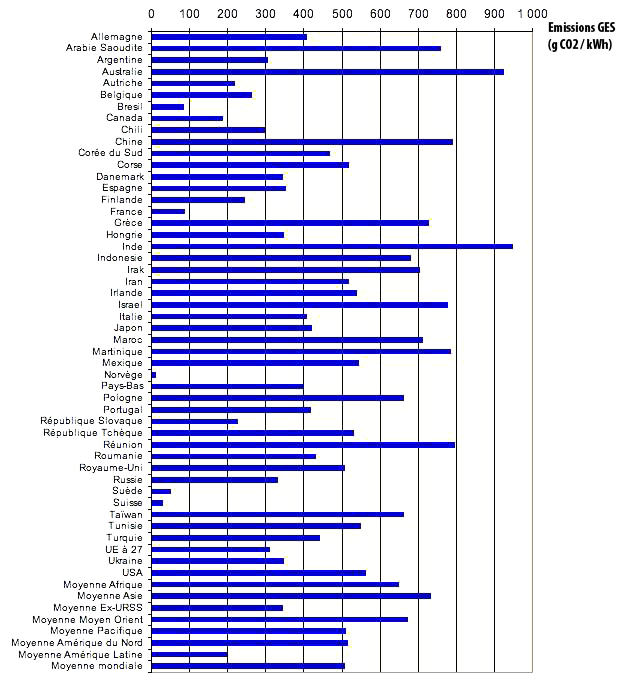
CO2 emissions per electric kWh for a number of countries in 2006.
(the names are in French but easy to guess !)
Source: International Energy Agency, 2008.
When electricity is mostly produced with fossil fuels, which is the case in most countries in the world (only France, Switzerland, Norway, Brazil and Sweden are not in this case), then the CO2 emissions per km can become close to what they are with oil for a car that has the same mass and engine power (if most of the electricity generation is done with coal it can even be superior).
What global picture for one car?
We can see, at this point, that, when discussing the advantage of electric cars, we must be more comprehensive than what is generally done, and:
- include the emissions associated to the manufacturing of the car in both cases,
- compare vehicles of equal mass and power, because often electric the vehicles assessed are compared with standard cars that are heavier and more powerful (which advantages electric cars, of course),
- not compare theoretical calculations, or data that comes from prototypes, for one category of vehicles, with data coming from “real life” use for others, knowing that real life is never as optimized as theoretical calculations or prototype use. For example, the emissions given by car manufacturers in Europe are 30% to 50% lower to what comes from real life observations,
- for electric cars, include in the average consumption accessories that are not used during the test on a sunny day in spring, but… all the rest of the year ! It includes heating or air-con, lights, windshield wipers, and all the small electric engines that are everywhere in a modern car,
- include the full life-cycle emissions of electricity generation.
From my experience, I can tell that finding comparative analysis that do all the above is far from easy…
What global picture for plenty of cars?
If we really want to massively shift petrol cars to electric cars, it might be a good idea to have a rough idea of the additional electricity we need to power all those vehicles. Let’s start our calculation with France:
- Road transports uses about 50 million tonnes of oil products, that is roughly 550 TWh (one ton of oil has an energy content of 11600 kWh, and one TWh = 1 billion kWh).
- An internal combustion engine has a yield of 20% on average. It means that the mechanical energy getting out of the engine is equal to 20% of the thermal energy coming from the combustion of oil. On the opposite, an electric engineas a yield of 80%, which means that the mechanical energy getting out of the engine is equal to 80% of the energy content of the electricity coming in (in both cases the excess energy is turned into heat). So the yield with electricity if much better, but…
- Storing electricity induces a 20% loss of the initial electricity, when for gasoline it is basically zero,
- For electricity there are distribution losses around 8% (from the power plant to the low voltage socket), when they are limited to 2% to 3% for fuels,
- For a gasoline car the auxiliaries (lights, wipers, and most of all heating in the winter) run on the engine and are already acounted for in the consumption per km, when for an electric car they run on the battery, and they represent 20% of the consumption of the engine on average.
- All included, the yield of electricity is 0,8 (yield of the engine) * 0,8 (yield of storage) * 0,8 (use of auxiliaries) * 0,92 (yield of distribution) ≈ 50% overall. For gasoline, it is 0,2 (yield of the engine)* 1 (yield of storage) * 0,98 (yield of distribution) = 0,2 in first approximation.
- As using electricity is 2,5 times more efficient than using gasoline, we see that with 220 TWh of electricity we could convert all French cars to electricity. ééà TWh, it’s half of the French electricity consumption in 2012 (which amounts to 450 TWh in rough figures).
- If we intend to produce this electricity with nuclear, we need to add 28 GW of installed power (producing 8000 hours per year), for a capital cost of about 110 billion euros (in 2012), and a lifetime of 60 years. We might save a little fraction of this cost by optimizing the existing nuclear plants, in particular for the night load. We must then add a grid reinforcement, because going from 550 TWh to 750 TWh travelling through the grid probably needs some upgrades. As a comparison base, the French GDP is 1900 billion euros per year, and, with 100 dollars per barrel of oil and 1,3 dollar per euro, importing fuels for road transport represents about 30 billion euros per year in France,
- If we intend to produce this electricity with windmills, we need roughly 110 GW of installed power (producing the equivalent of 2000 hours at full power per year), for a capital cost of about 110 billion euros (in 2012), and a lifetime of 20 to 30 years (so that over 60 years it costs 2 to 3 times more). Grid reinforcement will be also required, and even more than above (because the grid is dimensionned according to peak power production, and with 110 GW of windmills instead of 30 GW of nuclear the peak power injection will be higher). Then, as wind is intermittent and fatal, we might also add some intermediate storage for electricity if the batteries of the cars are not sufficient to take care of the variations. The means of storage most frequently used is waterworks, as explained below, for a cost close to 2000 euros per kW installed. In such a case, any fraction of the electricity that requires intermediate storage induces a doubling of the cost, or more.
- If we want to use photovoltaics, then we need 200 GW of installed capacity (producing the equivalent of 1000 hours at full power per year), for a capital cost of about 800 billion euros (in 2012), and a lifetime of 20 to 30 years (so that over 60 years it costs 2 to 3 times more). On top of that we also need grid reinforcement and intermediate storage, as the case may be.
- If we want to produce this electricity with gas fired power plants, that have a yield of about 50%, then France needs to import 450 TWh of gas annualy, that is only 20% less… than the oil saved !! (and an importation cost af about 8 billion euros). These plants will emit CO2, less than the oil saved, but the savong will be only of 40%, which is not enough to divide emissions by 4 to 6. Besides we must build 30 GW of gas fired power plants (producing 8000 hours per year), for a capital cost of about 15 billion euros (in 2012), and a lifetime of 40 years.
As it is the lowest investment cost of all the possibilities we have explored above, an obvious conclusion comes from this figure: if, in Europe, we wish to have at the same time electric cars and the “liberalization of EU energy markets”, the most probable is that we will end up with plenty of gas fired power plants.Then we will realize that we have a problem with the upcoming peak gas, that, in Europe at least, will thwart the marvellous spread of the electric car that everybody had in mind. 60% of the European gas comes from the North sea, which has passed its peak, and 20% from Russia, that will probably not increase much its exports to Europe (the remaining “reserves” are mostly in oriental Siberia, and will probably go… to the Chinese).
- If we want to produce this electricity with coal fired power plants, that have a yield of about 40%, then France needs to import 550 TWh of coal – about 70 million tonnes of coal – per year, for an approximate cost of 6 billion euros per year. We should build 30 GW of coal fired power plants (producing 8000 hours per year), for a capital cost of about 45 billion euros (and a lifetime of 40 years). In such a case, the CO2 emissions would increase by 50% !
Well, good or bad idea?
The electric car is no silver bullet, but as good an idea as the context in which it takes place. On a global scale, road transportation uses about 2 billion tonnes of oil every year, that is 20.000 TWh of energy. With the fact that an electric car is 2 to 3 times more efficient than a gasoline car, turning the road transportation system to electricity would require 8000 to 10000 TWh, or almost half the present electricity generation. Electricity in transportation is therefore an idea as good as the context in which it takes place: converting all cars to electricity, if in the same time the fleet is divided by 2, cars are used 4 times less, composed of small vehicles, and fed with electricity coming from pretty “clean” means of production (solar or nuclear), is definitely a solution to consider.
One of the avantages of having electric cars might be that it could transfer diffuse emissions (those of the exhaust pipes) to concentrated emissions (those of coal or gas power plants !), then allowing carbon capture and storage… but it has to be part of the plan !
But to advocate the massive conversion to electricity of all existing cars (or worse: all cars to come if we prolongate our desires), each car being used as much as today would be a “solution” that only moves the problem:
- it is a remedy worse than the disease if the country where it happens produces massively its electricity with coal (typically most US states). Of course, we avoid the urban pollution due to cars, but increase that due to coal power plants, and increase climate change, which bears potential threats greater than those of pollution,
- forgetting that the additionnal electricity production required is far from being ridiculous compared to the present installed power,
- forgetting that congestion, that uniquely comes from a great number of individual transportation means, would not disappear with electric cars. This statement is also partly valid for noise.
This reflexion is not valid for hybrid cars, that own both an electric engine and a thermal engine, and are more efficicent than “classical” cars (because they get back the kinetic energy when braking to convert it into electricity, and use the electric motor at low regimes, when the thermal engine has a very low efficiency), because these cars do not require additionnal power plants.
But this technological innovation does not eradicate all inconvenients of trafic: some gasoline is still required, even if it less than for the equivalent conventional car, (and oil is not renewable, still), and with a continuing city spreading we will get an increasing fleet of vehicles, and thus an increasing congestion.